
Exporters believe the situation will also have a grave outcome for employment, with large numbers of casual laborers looking at no work, as well as downstream units facing a loss of work, reports Subhayan Chakraborty.

Closely watched by the world for any escalation, the Iran-Israel conflict is already showing early signs of stress for India Inc - longer deliveries, doubling freight rates, extended working capital cycles, and higher costs. For those yet to feel the heat, there is growing apprehension and nervousness over future developments, observed industry executives.
India's exports contracted 12.2 per cent to $34.48 billion in December 2022, mainly due to global headwinds, and the trade deficit widened to $23.76 billion during the same period, according to official data released on Monday. Imports in December 2022 also declined 3.5 per cent to $58.24 billion as against $60.33 billion in the year-ago period. In December 2021, exports stood at $39.27 billion and the trade deficit was at $21.06 billion.

The apparel and engineering sectors have already witnessed the trend in the past one week. If this continues, it can have an impact on the overall export demand in the coming months, considering that Europe is the largest national export market for India.

A combination of externalities such as global trade wars and slowing growth, continuing glitches in accessing offsets under the GST regime, which has created a liquidity crunch for smaller exporters, and the growing competitiveness of smaller countries are causing the slowdown.
Exporters on Thursday demanded fiscal incentives, tweaking in customs duties on certain products and credit at affordable rates in the forthcoming Budget to boost exports and create jobs. In a pre-budget virtual meeting with Finance Minister Nirmala Sitharaman, the Federation of Indian Export Organisations (FIEO) said the depreciation of the rupee against the US dollar is affecting exports' competitiveness and the sector requires more support. "Creation of employment is the biggest challenge faced by the country...We would urge the government to provide fiscal support to units which provide additional employment in the export sector," the exporter's body said.
According to Ajai Sahai, director-general and CEO of Federation of Indian Export Organisations, rising cases are a cause for concern as it adds to the uncertainty and may impact exports.

Bharatiya Janata Party's prime ministerial candidate, Narendra Modi, last month urged small traders to compete with foreign retail chains through e-commerce.

India's exports contracted by 22 per cent, the steepest decline in the last three years, to $32.97 billion in June on account of global demand slowdown, especially in the Western markets like the US and Europe. According to the data of the commerce ministry, the trade deficit in June stood at $20.3 billion against $22.07 billion in the same month last year due to a fall in exports and imports. The inbound shipments during the month under review declined by a steep 17.48 per cent to $53.10 billion.
Import segments which recorded negative growth include gold, silver, transport equipment, coal, fertiliser, machinery and machine tools. However, exports of oil seeds, coffee, rice, tobacco, spices, pharma, and chemicals reported positive growth in June.

'His death is an irreparable loss to the nation'.

Work on a dozen decisions to start by next week.
Economists polled in a recent survey by Ficci unanimously felt that the rupee will continue to be under pressure in 2018-19
With exporters' claim for over five months still pending, liquidity has been wiped out and the process of finalising new contracts has been held up.

For the first time, the event will take place across three locations in Delhi: Bharat Mandapam at Pragati Maidan, Yashobhoomi Convention Centre at Dwarka, and India Expo Mart at Greater Noida.
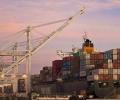
After contracting for six months in a row, the country's exports grew by 5.27 per cent to $27.4 billion in September, Commerce and Industry Minister Piyush Goyal said on Thursday.

Sectors with positive growth during the month include rice, iron ore, oil seeds, oil meals, meat, dairy and poultry products, pharmaceuticals, coffee, engineering goods, and plastic.

Many economists say only a substantial rise from October would point to a real recovery.
The rising dependence on discounted crude oil has resulted in India's trade deficit with Russia hitting the second-highest place last year, after China, reveals Department of Commerce data. From April through January 2022-23 (FY23), India's maximum trade deficit was with China, at $71.58 billion. This was followed by Russia, where the deficit expanded sevenfold - from $4.86 billion in April-January of 2021-22 (FY22) to $34.79 billion during the same period in FY23.
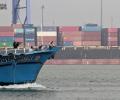
After recording positive growth in September, India's exports declined 5.4 per cent to $24.82 billion in October on account of dip in shipments of petroleum products, gems and jewellery, leather, and engineering goods. Trade deficit in October narrowed to $8.78 billion as against $11.76 billion, as imports also fell 11.56 per cent to $33.6 billion during the month under review.

De Beers, the world's premier source for rough diamonds, has painted an attractive picture for jewellery demand.

The country's exports grew 5.37 per cent year-on-year to $27.24 billion in January 2021, mainly driven by healthy growth in pharma and engineering sectors, according to provisional data of the commerce ministry. Trade deficit during the month narrowed to $14.75 billion from $15.3 billion in January 2020. It was $15.44 billion in December 2020. Imports in January 2021 rose 2 per cent to $42 billion.
The country's exports dipped 8.74 per cent to $23.52 billion in November on account of contraction in shipments of key sectors like petroleum, engineering, chemicals and gems and jewellery, official data showed on Tuesday. Trade deficit during the month narrowed to $9.87 billion as imports too declined by 13.32 per cent to $33.39 billion.
Imports too declined 26 per cent to $29.47 billion in August, leaving a trade deficit of $6.77 billion.

From toys, footwear and furniture to insulated flasks, smart meters, and air coolers - the Central government over the last decade has mandated higher standards for production and imports of such items. Sample this: Till 2014, there were 14 Quality Control Orders (QCOs) covering 106 products. By the latest count, there are 156 QCOs on 672 products.
Imports increased by 4.5 per cent, the highest growth in the last six months as crude oil and gold shipments shot up in the month.
Imports rose by 1.44 per cent to $43.44 billion in March 2019.
Out of 30 key export sectors, as many as 22 showed negative growth in September.

Motherson Sumi, Tata Steel, Jaguar Land Rover will face higher cost.
Imports too tumbled by 58.65 per cent to $17.12 billion in April from $41.4 billion in the same month last year, according to the data by the commerce and industry ministry.
Export sectors that showed positive growth last month included chemical, iron ore, electronics, marine products and pharmaceuticals. Decline in overall imports, including oil and gold, led to narrowing of trade deficit.
Barring rice, spices, iron ore and pharmaceuticals, all the remaining 26 key sectors registered negative growth in May. Imports too plunged 51 per cent to $22.2 billion in May.

Exports in May 2012 stood at $24.77 billion.

Assocham expressed concern over the precarious situation that the manufacturing sector is in, observing that if the trend does not reverse with monetary and fiscal measures it would be difficult for the industry to generate jobs.
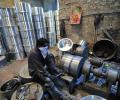
With the Covid-19 pandemic showing signs of ebbing and economic activity picking up, factory owners in Jalandhar had hoped that the worst was over. However, the heat wave in April and extensive power cuts that came with it, have crushed their hopes. The city's large number of micro, medium and small enterprises (MSMEs) are now gearing up for yet another struggle, this time to survive with the shortage of power that is severely impacting their operations.

To mark the first anniversary of the Sterlite firing anniversary -- 13 people died and several were injured when the Tamil Nadu police fired on a large crowd protesting -- various organisations will hold rallies and meetings in the port city.

The trade to-and-from India so far is not affected. But if the situation continues to remain the same for the next two to three months, it could definitely hurt India trade, including essential cargo.

Spurring the economy, currently in the throes of a slowdown, remains the prime focus for most ministries, but the government is also looking to make women's welfare and environmental protection key to policymaking in this term.

The list has been sent to Governor Ram Naik for approval.

The Swadeshi Jagran Manch (SJM) on Friday opposed a regulatory body's recommendation for environmental release of genetically modified mustard, calling it "dangerous" and urged the Centre to ensure that the crop's seed is not allowed to be planted "now or ever". In a letter to Union Environment Minister Bhupender Yadav, the RSS-affiliated organisation accused the Genetic Engineering Appraisal Committee (GEAC) of functioning in an "irresponsible fashion" and said the claims made in support of genetically modified (GM) mustard were "completely untrue, unsubstantiated and wrongly projected". "Swadeshi Jagran Manch has all along been opposing this dangerous and unneeded GM mustard being brought in through the backdoor as a public sector genetically modified organism (GMO)," organisation co-convenor Ashwani Mahajan said in the letter.
